
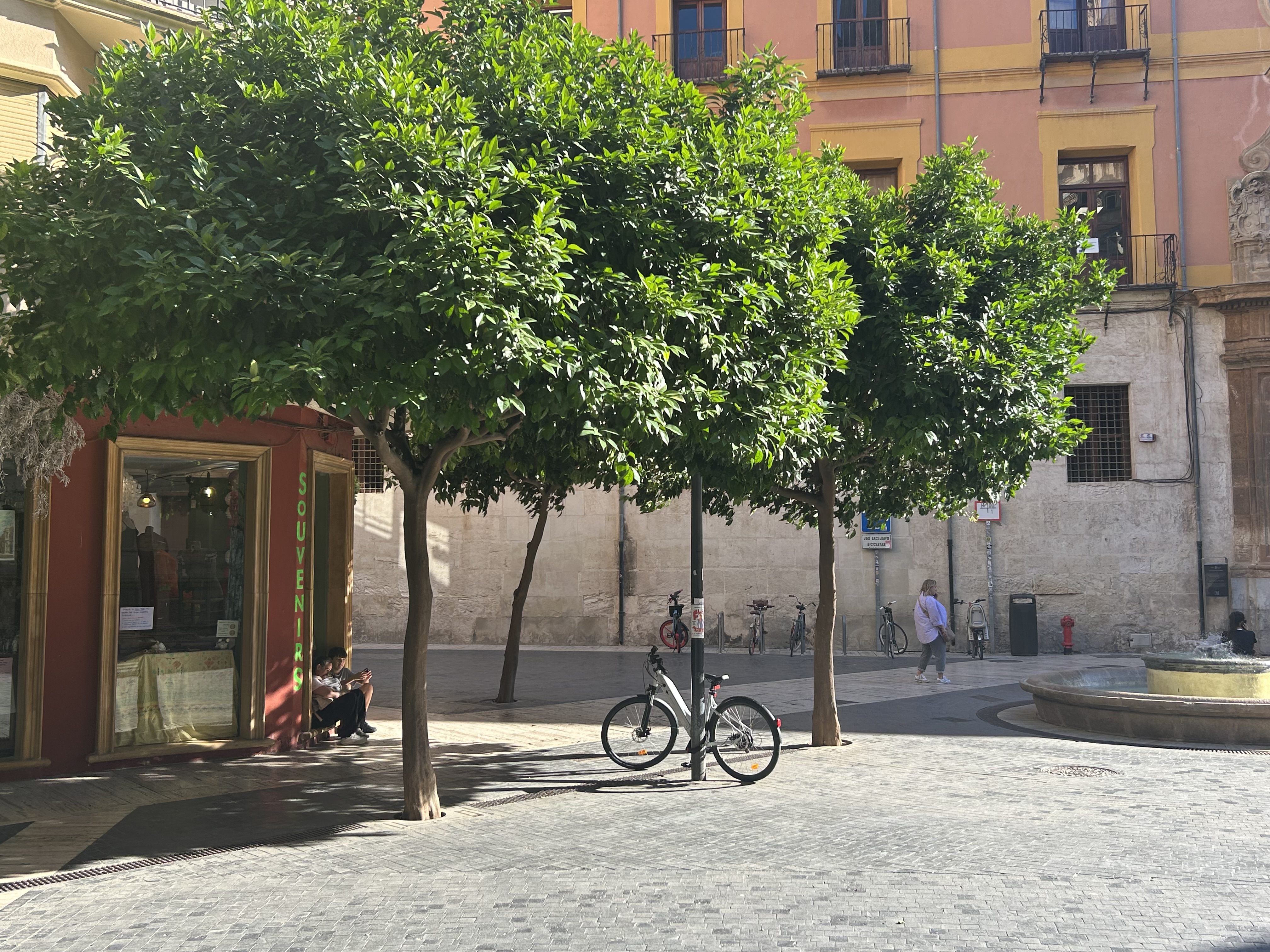
Mid-May, around midday. A small plaza in central Murcia: orange trees, a souvenir shop corner, cobblestones that have been receiving the sun since morning. The image shows three things simultaneously: an empty center, two bodies at precisely the right position, and two trees that have no idea how much work they are doing. Heat organized all of it.
I. The surface
The cobblestone in the center of the frame is empty. Not because there is nobody in the plaza—there are people, they appear in the photograph—but because the cobblestone at this hour is radiating, and bodies have read that fact and moved accordingly. Heat has done what no sign, no fence, no institution has done: it has reorganized the space, sorting who stays where with a precision that no urban plan authored and no maintenance crew will need to uphold.
This is how heat administers public space when no institution does: not by force but by making certain positions untenable. The empty cobblestone is not empty by accident. It is as administered as a closed gate—but the gate is thermal, and it has no authority behind it.
II. The convergence
The two people in the photograph have not simply found shade. They have found the densest point of shade available in this corner of the plaza: the intersection where the tree canopy overhead and the building wall beside them overlap their shadows. Neither source alone would be sufficient. The tree canopy produces dappled shade with gaps; the wall’s shadow has no canopy above it. At their intersection, both deficits cancel.
The bicycle is in the tree shadow too. Everything that can be in shade is in shade. The space has been read with a fidelity that no institution organized and no map produced. Heat made the geometry legible; the bodies did the reading.
III. The trees
The naranjos were almost certainly not planted for shade. In Murcia’s plazas and streets, the orange tree is historical, ornamental, culturally specific: a tree whose presence signals something about the city’s character, its relationship to its agricultural past, its Mediterranean self-presentation. The decision to plant naranjos here was made for reasons that had little or nothing to do with thermal relief. And yet, at this hour, these trees are doing the most consequential thermal work in the plaza. Their canopy is what makes the corner viable. Without them, the two people in the photograph would be elsewhere… or not outside at all.
This gap between why something was placed and what heat requires of it is one of the most consistent findings of walking in Murcia in May. The city’s thermal commons—the shade that is actually usable, unconditional, free—is almost never the product of thermal intention. It is the byproduct of decisions made for other reasons: historical, ornamental, commercial, and architectural. Heat does not care why the tree was planted. It uses what is there.