
This year one of my main research lines turns to what usually stays out of frame: what happens to pigs after the moment we typically call “the end.” Not the living animal alone, but its persistence as slurry, bones, skins, dust, odors, paperwork, measurement regimes, and environmental conflict. These are not leftovers that quietly disappear; they are materials that keep acting—moving through soils and aquifers, saturating air, overloading infrastructures, and becoming objects of dispute, denial, regulation, and care.
Thinking from “afterlife” shifts the center of gravity of multispecies research. Much multispecies ethnography has taught us to take seriously interspecies relations, cohabitation, and becoming-with. My wager here is slightly different: to ask what it means to do multispecies work when the key actors are not only living companions, but post-life fragments—materials that insist, leak, accumulate, and return. In places shaped by intensive pig farming, residues don’t simply mark ecological harm; they actively reorganize rural life, political debate, and forms of expertise.
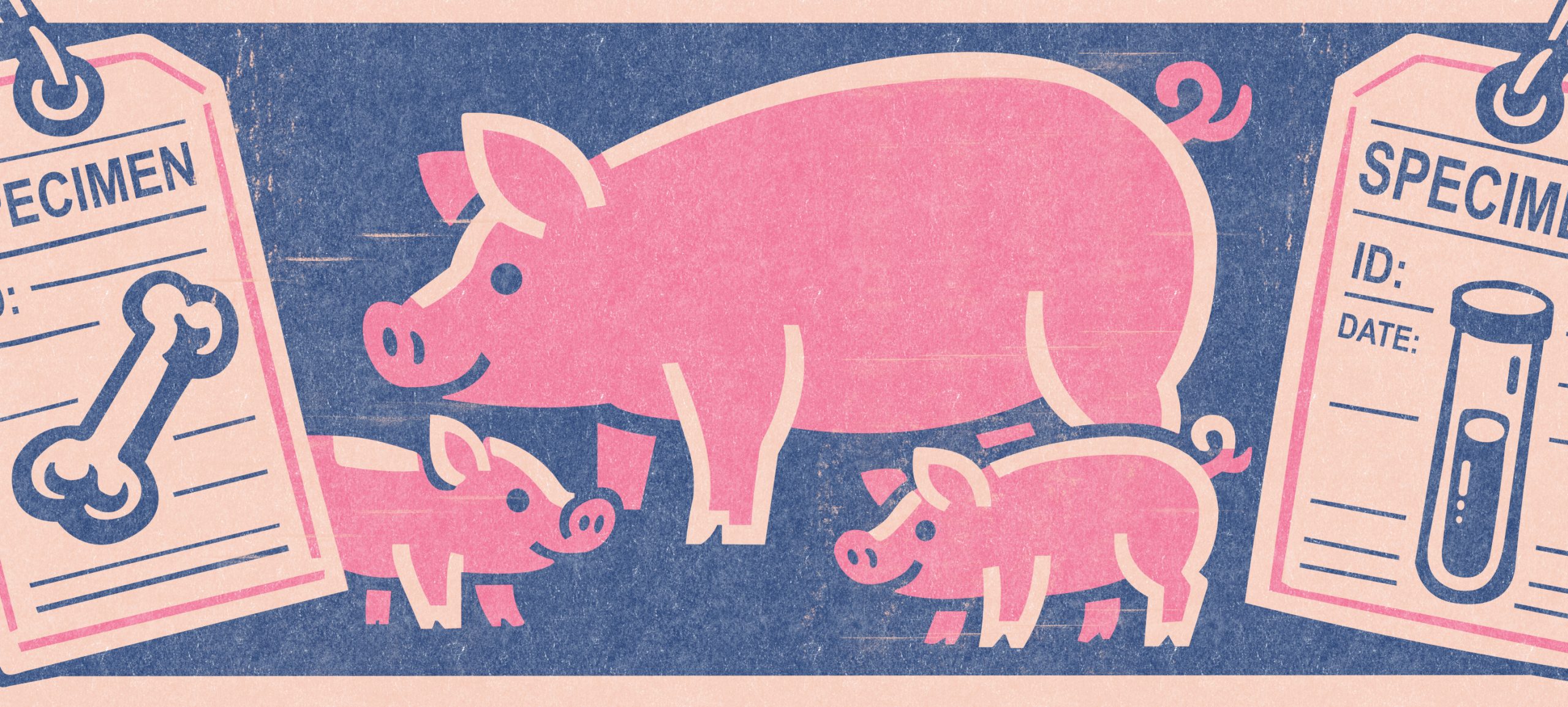
To study these conditions, I’m developing specimenography as a methodology: a curatorial, multimodal way of doing ethnography with fragments. Specimenography treats residues not as inert waste, but as annotated specimens—selected and carefully documented fragments that condense broader relations between industrial production, environmental governance, and uneven forms of vulnerability. A specimen can be a purín trace, a smell that people learn to interpret, a skin turned by an industry, a regulatory document that redraws a territory, or a sample that becomes evidence. The point is not to “represent the whole system,” but to build a practice of sustained attention to what persists—and to the worlds that residues make.
This is also where care becomes complicated. In industrial landscapes, care is not only intimacy or empathy; it is often infrastructural and contested: monitoring, containment, maintenance, thresholds, repairs that redistribute harm rather than resolve it. Specimenography tries to work with that ambivalence by staying close to the material politics of remains—how residues become governable, how communities live with them, and how responsibilities get assigned, displaced, or refused.
Methodologically, this research line is built as a sequence: trace residues across sites, gather and document fragments, transform them into specimens through annotation and curation, and then open them to collective interpretation through public-facing formats. The goal is not only analysis, but also the design of shareable devices—prototype “trays,” small zines, and a digital cabinet—that can function as tools for thinking and debating ecological harm. Specimenography, in other words, is both an analytic method and a way of making knowledge usable beyond academia.
If there is a single guiding question for this year, it is this: What does it take to remain accountable to the afterlives we continuously produce? Following pig residues is a way of tracking how industrial life exceeds itself—how it continues materially, politically, and atmospherically—long after the animal is gone. Specimenography is my attempt to meet that persistence with a method that can hold fragments in view without forcing closure, and that can turn “what remains” into a shared matter of concern.