
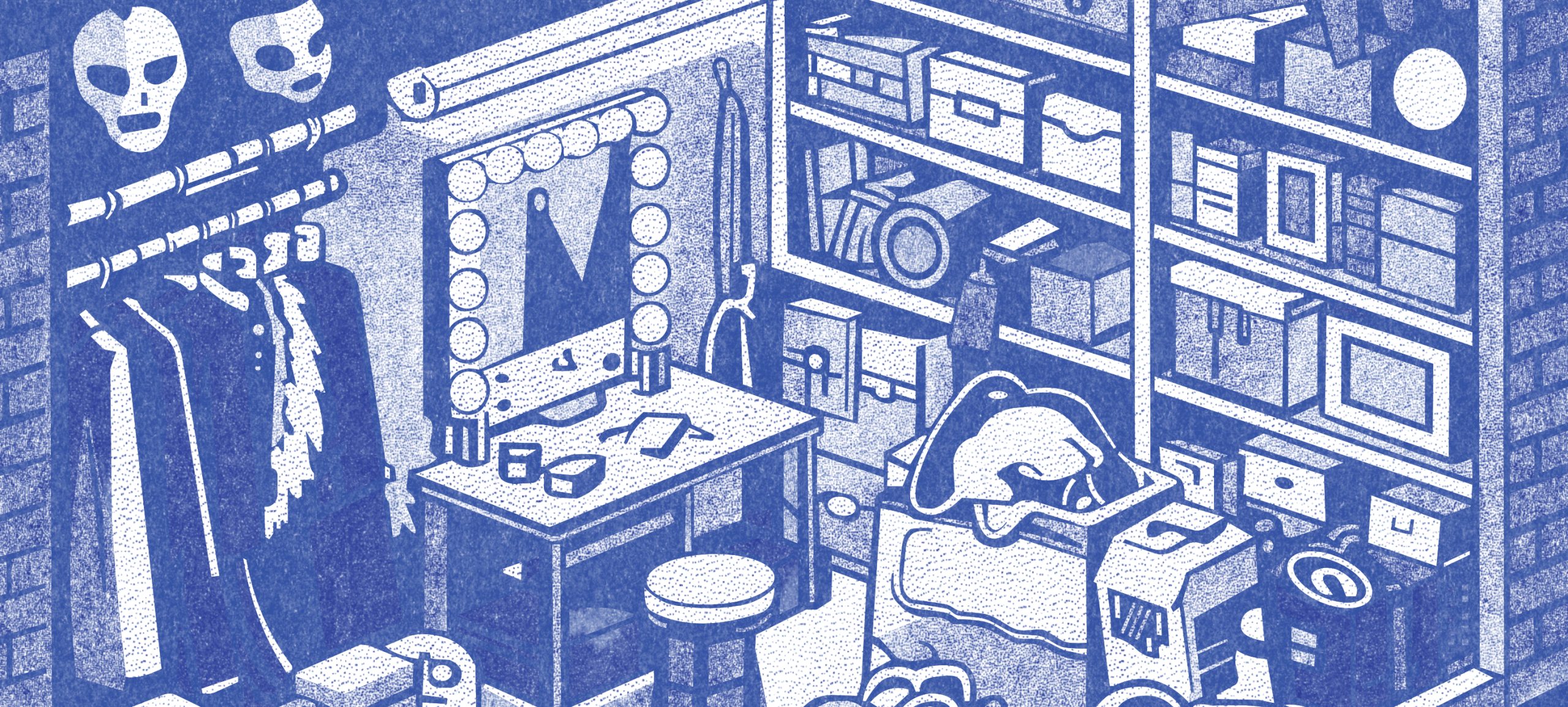
Download the zine here
Download a russian version here
As part of my work on MINIMA—and my longer-term intention to build an independent editorial workshop specializing in small, quick formats—I collaborated with Francisco Martinez to produce a zine for the presentation of his book The Future of Hiding.
This zine was a small editorial sprint: a compact object designed to travel easily, read quickly, and still carry atmosphere. The goal was not to “summarize the book,” but to translate a set of its tones—shadows, concealments, ordinary infrastructures of privacy—into a printed artifact that could accompany a public moment (a talk, a launch, a room with people).
In other words: not a flyer, not a catalogue, not “merch.” A zine as an interface.
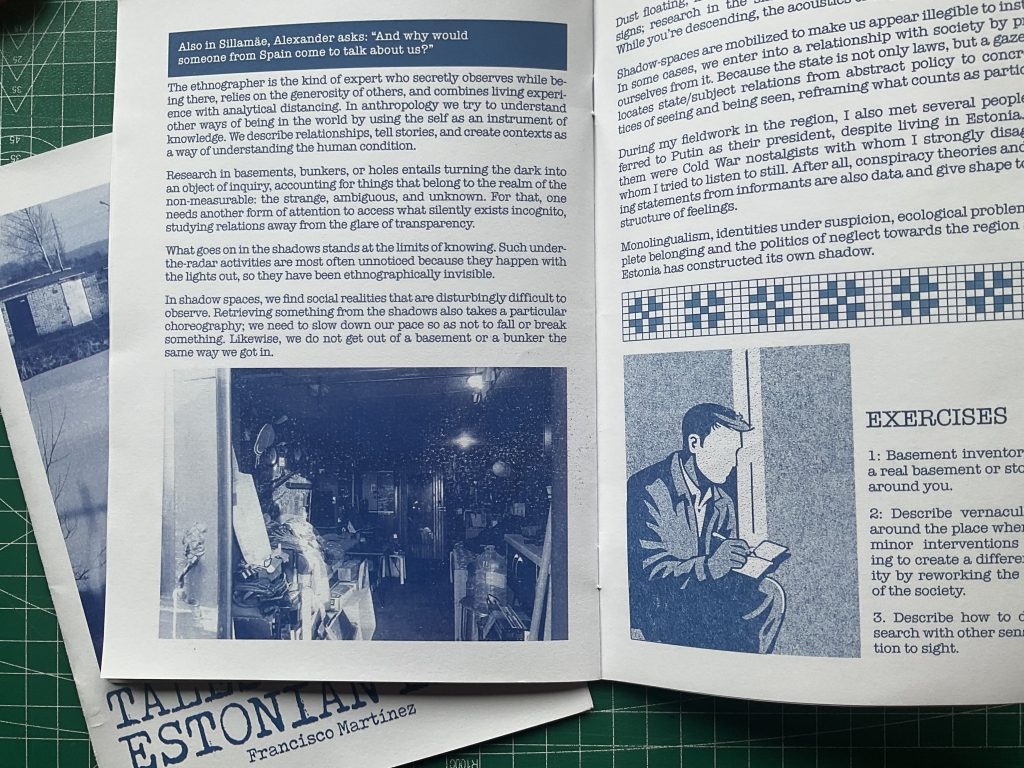
The format: bigger than my usual, still fast and tactile
Most of my own editions tend to stay very small—quick folds, minimal surfaces, a lot of constraints. For this collaboration we went slightly larger, to give more breathing room to text and images while still keeping production simple.
Specs (in plain terms):
- Structure: 4 × A4 sheets
- Fold: each sheet folded in half → A5 reading surface
- Binding: stapled (saddle stitch)
- Logic: a readable narrative thread + image rhythm + a few “graphic pauses”
Working with this format was a useful shift: enough space for a calm reading experience, but still within the “doable” zone of fast prototyping and quick iteration.
Editorial idea: narrative clarity + visual texture
From the beginning, we wanted the zine to feel easy to read—short paragraphs, clear pacing, not too much typographic noise—while also holding onto the material mood of the project.
So we worked with a simple editorial triad:
- A narrative thread (legible, calm, not rushed)
- Photographs as anchors (places, scenes, atmospheres)
- Illustrations as interruptions (graphic thinking, not decoration)
The illustrations were especially important: they allowed us to carry concepts without “explaining” them too much, and they created an internal rhythm—like breathing spaces inside the text.
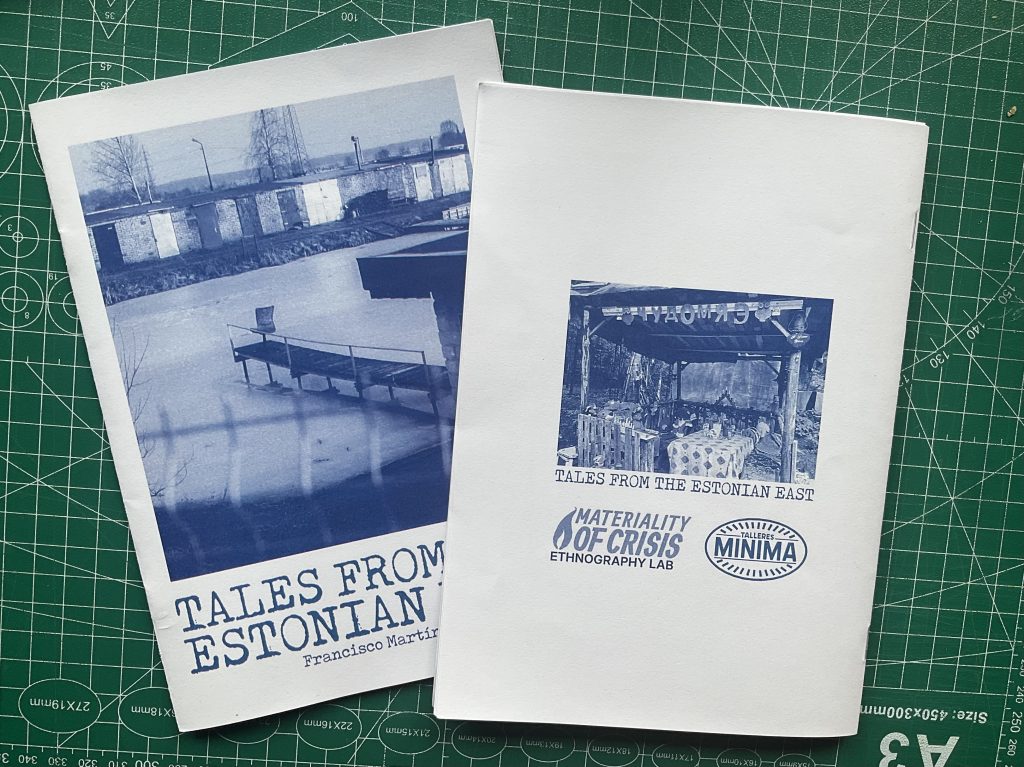
Riso-style as method: learning how to “print” without printing
This project also became a technical rehearsal: I used it to experiment with riso-style image treatment—limited palette, grain, texture, high contrast, and that particular mix of softness and sharpness that makes riso feel simultaneously cheap and precious.
Even when one is not printing on an actual risograph, thinking “riso-style” can be a workflow discipline:
- reduce tonal range
- embrace imperfection
- design for texture (not for resolution)
- make images communicate through silhouette + density
It’s a way of asking: what does this image do when it is stripped down to its minimum printable personality?
Third-party work: a different kind of ethnographic craft
This zine is also an experiment in a different mode of practice: bringing someone else’s project into material form.
That shift matters. When you make your own publications, you can improvise endlessly—you can change direction midstream, follow a hunch, privilege obsession over clarity. Third-party work asks for something else:
- translation (from a person’s research voice into a shared editorial object)
- protocols (versions, deadlines, scope, deliverables)
- negotiation (what matters most, what can be cut, what must stay)
- careful constraint (the artifact has to land, not just “be interesting”)
For me, this was training in collaborative editorial practice: learning flows that can scale beyond my own projects—toward the kind of independent workshop I want MINIMA to become.
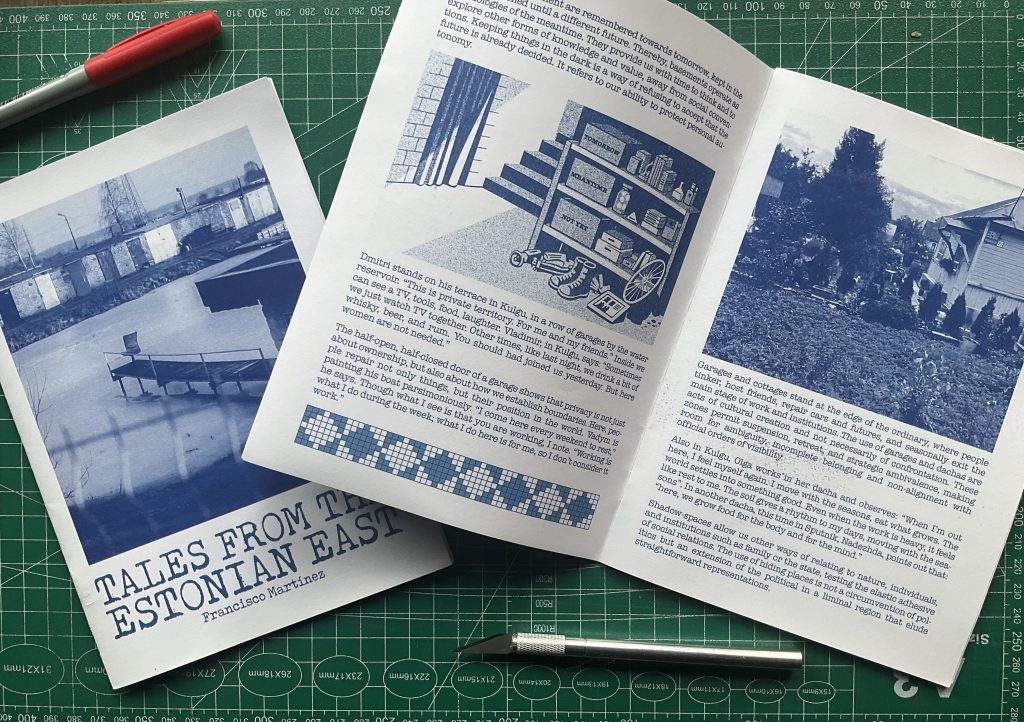
Credits and context
This zine was produced as part of my ongoing practice around MINIMA: an editorial lab focused on small editions and usable knowledge, and increasingly, on third-party collaborations—working with researchers, artists, and institutions to prototype publications that are both rigorous and inhabitable.
It accompanied the presentation of Francisco Martinez’s book The Future of Hiding, published by Cornell University Press.
Zine text and photos: Francisco Martínez
Zine creation and illustrations: Santiago Orrego
Logos and institutional context on the back cover reflect the collaboration ecology around the project, including Materialities of Crisis Lab.